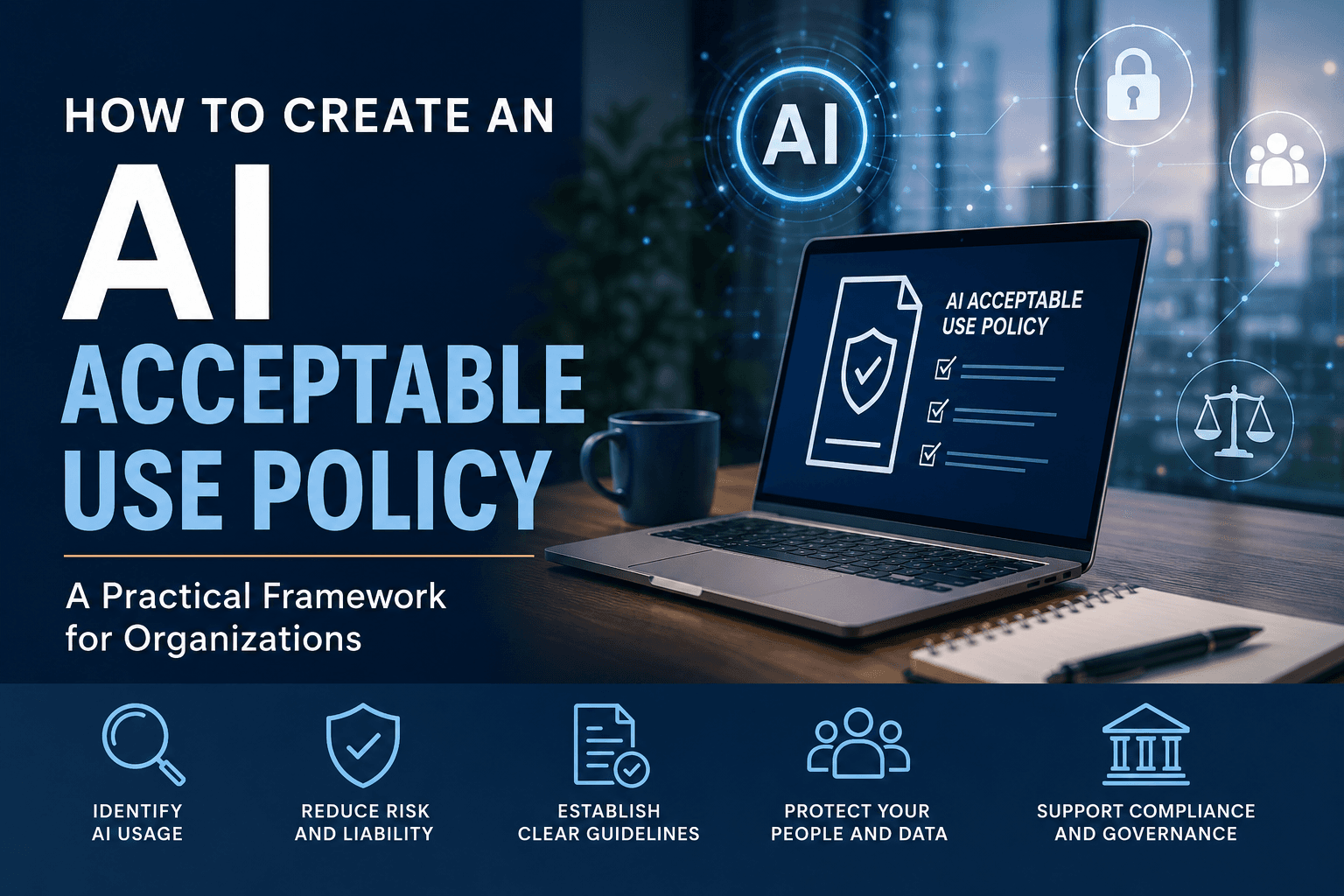
An AI Acceptable Use Policy is a governance document that defines how employees within an organization may and may not use artificial intelligence tools. It establishes approved applications, prohibited uses, data handling rules, and accountability standards. Every organization that uses, including those where employees access AI through embedded features in approved software, AI tools in any form needs one, regardless of size or industry.
Most organizations already have AI in use whether they realize it or not. Microsoft 365 includes Copilot. Google Workspace includes Gemini. CRM platforms, ERP systems, and productivity tools have embedded AI features that employees use daily. The question is no longer whether AI is present in your organization. The question is whether its use is governed.
What follows is a plain-language breakdown of why an AI Acceptable Use Policy matters and a five-step framework for building one, drawn from real client assessments across Missouri and the broader region.
The Wake-Up Call Most Leaders Experience
Not long ago, I was meeting with a business owner who confidently told me they had solved the AI problem.
"We block all AI tools internally," he said.
From his perspective, the issue was settled. No ChatGPT. No AI. No risk.
As we talked, I recommended we perform an audit of their environment. He was hesitant. He was confident in the controls they had in place and skeptical there was anything to find.
Eventually, he agreed.
What we found surprised both of us.
The organization was not avoiding AI at all. AI was already woven into daily operations in ways leadership had not considered. Microsoft Copilot features were active through Microsoft 365. Google Gemini was available through the organization's Google Workspace environment. And employees working remotely were accessing AI platforms on company-issued devices with company information.
Nobody was trying to violate policy. Nobody was trying to create risk. They were simply trying to get their jobs done more efficiently.
The problem was not employee behavior. The problem was that leadership believed AI use had been eliminated when, in reality, it had simply become harder to see.
AI Today Feels a Lot Like Cybersecurity Did Ten Years Ago
I have spent years helping organizations across Missouri, Arkansas, Kansas, and Oklahoma improve cybersecurity, and I cannot help but notice the parallels.
Ten years ago, most organizations understood cybersecurity was important. They knew they needed policies and safeguards. But many assumed they had more time. Security initiatives were pushed to next quarter. Policies sat unfinished. Risk assessments stayed on the to-do list.
Then ransomware became a boardroom issue. Suddenly, cybersecurity was not just an IT concern. It became a business risk, a financial risk, and a reputation risk.
Today, we are seeing the same pattern with artificial intelligence. The difference is that AI adoption is moving even faster. Employees are not waiting for leadership to develop a strategy. They are using the tools that help them work faster, write better, and analyze information more efficiently.
Whether leadership realizes it or not, AI is already finding its way into most organizations.
Why Every Organization Needs an AI Acceptable Use Policy
For city leaders, executive teams, business owners, and department managers, this is not simply a technology conversation. It is a conversation about:
- Risk management
- Data protection
- Regulatory compliance
- Liability exposure
- Public trust
- Organizational accountability
An AI Acceptable Use Policy establishes clear expectations for how artificial intelligence can and cannot be used within your organization. It helps employees understand their responsibilities when interacting with AI systems. Even organizations that choose to prohibit AI use need a policy. Doing nothing is no longer a strategy.
Insurance Companies Are Starting to Pay Attention
Cyber liability insurance carriers are beginning to ask questions about AI governance and acceptable use policies during application and renewal processes.
Organizations are expected to have the controls they claim to have in place. If a claim occurs and those controls cannot be demonstrated, it creates additional scrutiny and potential coverage challenges.
For public sector organizations, municipalities, and critical service providers, the implications are even greater. A cybersecurity incident involving AI does not just create operational challenges. It can quickly become a public trust issue. Leaders may find themselves answering questions from governing boards, city councils, auditors, insurance carriers, and regulatory agencies.
Most leaders I work with are not trying to become AI experts. They are simply looking for confidence that reasonable safeguards are in place and that risks are being managed responsibly.
The Biggest Mistake Organizations Make
One of the most common misconceptions is believing that blocking ChatGPT means you have addressed AI risk.
The reality is that AI is no longer a single website. AI is embedded throughout today's technology ecosystem. It lives inside:
- Microsoft 365 and Google Workspace
- CRM and ERP platforms
- Business productivity applications
- Browser extensions
- Marketing and design tools
- Customer service systems
Governance cannot focus solely on blocking access to one application. Governance must address how AI is being used across the entire organization. That is a very different challenge.
A Five-Step Framework for Creating an AI Acceptable Use Policy
Creating an effective AI Acceptable Use Policy does not have to be complicated. Here is the framework we use with clients.
Step 1: Stop Guessing and Conduct an AI Audit
Leadership's perception of AI usage rarely matches reality. That is not because employees are doing anything wrong. It is because AI is now embedded into hundreds of applications people use every day.
Before writing a policy, you need facts instead of assumptions. Conduct a thorough review of installed software, cloud applications, browser extensions, department-specific tools, and existing AI capabilities within approved applications. The goal is not to catch employees doing something wrong. The goal is to understand how AI is actually being used.
Step 2: Understand How Data Flows Through AI Systems
Once you have identified AI usage, understand how information moves through those systems. Ask:
- What information is being shared?
- Where is it stored, and is it retained?
- Is it used to train public models?
- What security controls and contractual protections exist?
These answers should drive your governance decisions. Not marketing materials. Not assumptions.
Step 3: Define Approved AI Applications and Usage Guidelines
Once you understand your environment, establish clear rules. Your policy should identify approved and prohibited AI applications, acceptable business uses, restricted data types, user responsibilities, and documentation requirements. The goal is not to eliminate innovation. The goal is to create guardrails that allow innovation to happen safely.
Step 4: Define Consequences for Policy Violations
Every policy should clearly explain what happens when it is ignored. This section should address why the policy exists, the risks created by non-compliance, potential organizational impacts, and disciplinary actions. People are far more likely to follow policies when they understand the reasons behind them.
Step 5: Create a Process for Requesting New AI Tools
AI technology is evolving rapidly. A policy that is overly restrictive encourages employees to find workarounds. Instead, establish a clear process for evaluating and approving new AI applications, including business justification, security review, privacy review, compliance review, and management approval. When employees know there is a path to approval, they are much more likely to follow the process.
The Real Goal Is Responsible AI Use, Not Restriction
The purpose of an AI Acceptable Use Policy is not to stop people from using AI. The purpose is to ensure AI is used responsibly. Most organizations will benefit from AI in some capacity. The question is not whether AI will be used. The question is whether its use will be intentional and governed.
Organizations that establish clear expectations today will be in a much stronger position to take advantage of AI while protecting their data, operations, reputation, and stakeholders. Organizations that wait may eventually find themselves reacting to a problem they could have prevented.
If you are working through an AI governance initiative or need help assessing where AI is currently being used in your environment, our team works with organizations across Missouri and the surrounding region on exactly this kind of advisory work. You can learn more about our AI and automation services or reach out directly to schedule a conversation.